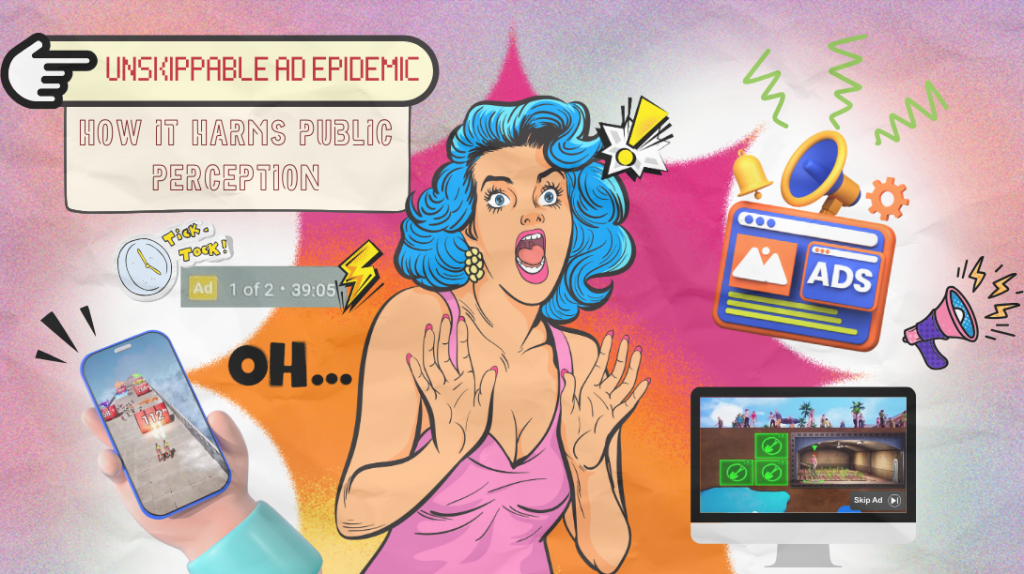
Imagine sitting down, a hot meal on the table and a phone propped up against a pitcher of water. You click on a YouTube video about some random topic, picking up a spoonful of food… and then two unskippable ads play.
It’s impossible to ignore the sheer amount of advertisements in our daily lives, especially online. Almost every website has at least one ad somewhere. Usually, they are pop-up ads you can close with a single press or it’s a small one on the side or at the bottom that does not affect the usability of the site. However, platforms such as YouTube, Twitch, Instagram, and Facebook can’t just show ads on the side.
It’s frustrating to navigate and use the internet when everyone’s trying to either sell a product or brick your PC. Whether on YouTube or on the radio, it can feel like there’s always something being shoved into our faces.
Of course, people also recognize the need for ads in the online sphere. Keeping a website up is expensive. It requires servers to run; meaning, it needs money. Ads are the solutions many have chosen to employ. Some see the occasional, skippable ads on YouTube as a fair trade for free videos. After all, the rise of subscription-based streaming services has made it hard to find any other platform to use for free.
Yet, YouTube’s monopoly over the free video sharing market has allowed it to make ads more and more prominent and unavoidable. First, they began with unskippable, 15 second ads. Then, it became up to two, eating up a full 30 seconds before showing the intended video. It may not seem like a lot, but when a meal is quickly growing cold with a growling stomach, it could feel like an eternity. Users remember the ads, no matter how uninteresting they find it to be, as long as they see it over and over again. And when their experience is disrupted by the same name over and over again, they begin to associate the name with annoyance.
Most people have learned to ignore those pesky ads about some guy who supposedly cured his incurable disease with a home remedy or the countless obscene pop-ups. Encountering them so frequently, they become the visual definition of white noise. Even the hardest to navigate sites like Fandom have userbases that have learned how to navigate past all the ads.
Still, people have begun to notice the normalization of this. Old internet safety tips always recommended to stay far from sites with an overabundance of pop-ups as they may install viruses with one misclick. Yet, many sites have begun to resemble the textbook definition of a malware site. Whether its businesses trying to convince you to buy their product or malicious characters giving viruses, they all end up blending into each other. To a user, they’re just disruptions to their online experience. Consumers, understandably, aren’t happy.
Repeated exposure is a good way for people to remember, that much is true. It’s why when a brand rolls out a new form of advertising, it can be seen everywhere. In the streets, online, on TV, the radio, etc, repeated exposure is a good way to make a product stick. This isn’t just mindless placement. The online sphere has created countless new forms of advertising. However, this has also created a unique problem, a distinct annoyance among users for the constant disruption. But with the lack of regulations, there seem to be no stopping the unskippable ad epidemic.
Blog by Nicole Samson
 Ambidextr Media
Leave a comment